

Hey there! As a supplier of chelating dispersants, I often get asked about how these nifty little chemicals impact the drying time of coatings. It's a question that's been on the minds of many in the industry, and today, I'm going to dive deep into it.
First off, let's quickly talk about what chelating dispersants are. These are substances that can form complexes with metal ions, which helps in keeping particles dispersed in a solution. They're widely used in various industries, especially in coatings, to improve the stability and performance of the final product.
Now, the big question: Do chelating dispersants affect the drying time of coatings? Well, the answer isn't as straightforward as you might think. There are several factors at play here, and it really depends on the specific type of chelating dispersant, the coating formulation, and the drying conditions.
The Chemistry Behind It
To understand how chelating dispersants might affect drying time, we need to look at the basic chemistry of coatings. Coatings typically dry through either evaporation of the solvent or a chemical reaction, like cross - linking. Chelating dispersants can influence both of these processes.
Some chelating dispersants can interact with the solvents in the coating. For example, if a dispersant has a high affinity for the solvent, it might slow down the evaporation rate. This is because the dispersant - solvent interaction can hold the solvent molecules in the coating for longer, delaying the drying process. On the other hand, certain dispersants can enhance the evaporation by modifying the surface tension of the solvent, allowing it to evaporate more quickly.
In terms of chemical reactions, chelating dispersants can affect the cross - linking process. They might complex with metal ions that are involved in the cross - linking reaction, either accelerating or decelerating it. If the cross - linking reaction is sped up, the coating will dry faster. But if it's slowed down, well, you guessed it, the drying time will increase.
Types of Chelating Dispersants and Their Impact
There are different types of chelating dispersants out there, and each can have a unique effect on the drying time of coatings.
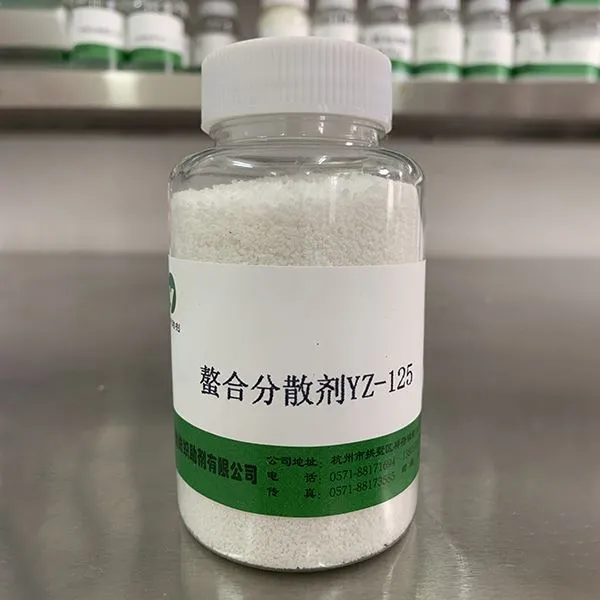

Phosphorus Free Chelating Dispersant: This type of dispersant, like the one you can find Phosphorus Free Chelating Dispersant, is becoming increasingly popular due to environmental concerns. It's designed to be more eco - friendly while still providing excellent dispersing properties. In some cases, these phosphorus - free dispersants can actually improve the drying time of coatings. They might not interact as strongly with the solvents, allowing for faster evaporation. And they can also promote a more efficient cross - linking reaction, leading to a quicker drying process.
Chelating Disperse Agent: Another common type is the Chelating Disperse Agent. These agents are known for their ability to disperse particles effectively. However, their impact on drying time can vary. Some chelating disperse agents might have a neutral effect on drying, while others can either speed up or slow it down depending on their chemical structure and the coating formulation.
Coating Formulation and Drying Conditions
The coating formulation itself plays a huge role in how chelating dispersants affect drying time. If a coating has a high solids content, the presence of a chelating dispersant might have a different impact compared to a coating with a low solids content. High - solids coatings typically dry faster because there's less solvent to evaporate. A dispersant in a high - solids coating might enhance the cross - linking reaction and further reduce the drying time.
Drying conditions are also crucial. Temperature, humidity, and air circulation all affect how quickly a coating dries. For example, in a high - humidity environment, the evaporation of the solvent will be slower. A chelating dispersant that normally speeds up drying in a dry environment might not have the same effect in a humid one.
Real - World Examples
Let's take a look at some real - world scenarios. In a recent project, a customer was using a traditional coating formulation with a standard chelating dispersant. They were experiencing longer - than - expected drying times. After some investigation, we found that the dispersant was interacting too strongly with the solvent, slowing down evaporation. We recommended switching to a Phosphorus Free Chelating Dispersant. Once they made the switch, the drying time was significantly reduced, and they were able to increase their production efficiency.
On the other hand, there was another case where a customer wanted to slow down the drying time of their coating to allow for better leveling. We suggested using a specific Chelating Disperse Agent that could interact with the cross - linking reaction and delay it. This way, they could achieve the desired smooth finish on their coating.
Conclusion
So, do chelating dispersants affect the drying time of coatings? Absolutely! But as we've seen, it's a complex relationship that depends on many factors. The type of dispersant, the coating formulation, and the drying conditions all come into play.
If you're in the coatings industry and looking to optimize your drying time, it's important to choose the right chelating dispersant for your specific needs. Whether you need to speed up drying for increased production or slow it down for better finish quality, we've got a solution for you.
If you're interested in learning more about our chelating dispersants or want to discuss your specific coating requirements, don't hesitate to reach out. We're here to help you find the perfect dispersant that will give you the best results in terms of drying time and overall coating performance. Let's start a conversation and see how we can work together to improve your coatings!
References
- "Coatings Technology Handbook" by Paul Oldring
- "Principles of Polymerization" by George Odian
- Industry research reports on chelating dispersants and coatings drying