

Tear strength is a crucial property in various materials, especially in textiles, plastics, and rubber products. A tear strength improver is a specialized additive that can significantly enhance the ability of these materials to resist tearing. As a supplier of Tear Strength Improver, I am often asked about how this product works. In this blog, I will delve into the science behind tear strength improvers and explain their mechanisms of action.
Understanding Tear Strength
Before we explore how tear strength improvers work, it's essential to understand what tear strength is. Tear strength refers to the force required to initiate or propagate a tear in a material. It is influenced by several factors, including the material's molecular structure, intermolecular forces, and the presence of defects or stress concentrations.
In materials like textiles, a high tear strength is desirable to ensure durability and longevity. For example, in outdoor clothing, strong tear resistance can prevent the fabric from tearing easily when snagged on branches or sharp objects. In the case of plastics and rubber, tear strength is crucial for applications such as automotive parts, conveyor belts, and packaging materials.
The Mechanisms of Tear Strength Improvers
Tear strength improvers work through several mechanisms, which can be broadly categorized into physical and chemical mechanisms.
Physical Mechanisms
- Reinforcement of the Polymer Matrix: Many tear strength improvers act as reinforcing agents. They are typically fine particles that are dispersed throughout the polymer matrix. When a tear starts to propagate in the material, these particles act as barriers, redirecting the tear path and absorbing the energy associated with the tearing process. For example, in rubber compounds, carbon black is a commonly used reinforcing filler. The carbon black particles create a network within the rubber matrix, which enhances the material's stiffness and tear resistance.
- Improvement of Interfacial Adhesion: In composite materials, the adhesion between different phases (such as fibers and the matrix in a fiber - reinforced composite) is critical for tear strength. Tear strength improvers can improve the interfacial adhesion by modifying the surface properties of the components. For instance, in a textile - resin composite, a coupling agent can be used as a tear strength improver. This agent reacts with both the textile fibers and the resin, creating a strong chemical bond between them. As a result, the composite can better withstand tearing forces.
Chemical Mechanisms
- Cross - linking Enhancement: Cross - linking is a chemical process in which polymer chains are connected by covalent bonds. Tear strength improvers can promote cross - linking in polymers, increasing the material's molecular weight and creating a more three - dimensional network structure. In rubber, sulfur is a well - known cross - linking agent. When sulfur is added to rubber along with a tear strength improver, it forms cross - links between the rubber molecules, making the rubber more resistant to tearing.
- Chain Entanglement and Mobility Modification: Some tear strength improvers can modify the chain entanglement and mobility of polymer molecules. They can either increase the entanglement density or reduce the chain mobility, depending on the specific requirements of the material. For example, in some thermoplastic polymers, a plasticizer can be used as a tear strength improver. The plasticizer molecules insert themselves between the polymer chains, increasing the chain mobility at low temperatures and reducing the brittleness of the material, thereby improving its tear strength.
Specific Applications of Tear Strength Improvers
The application of tear strength improvers varies depending on the type of material and the specific requirements of the end - use product.
Textiles
In the textile industry, tear strength improvers are used to enhance the durability of fabrics. For example, in denim production, a Tear Strength Improver can be applied during the finishing process. This improver can be a polymer - based compound that forms a thin film on the fabric surface, reinforcing the fibers and improving the tear resistance of the denim. Additionally, in technical textiles such as military uniforms and outdoor sportswear, tear strength improvers are essential to ensure that the fabrics can withstand harsh environmental conditions and physical stresses.
Plastics
In the plastics industry, tear strength improvers are used in a wide range of products, including packaging films, injection - molded parts, and blow - molded containers. For example, in polyethylene packaging films, a tear strength improver can be added during the extrusion process. The improver can be a filler or a polymer additive that enhances the film's tear resistance, reducing the likelihood of punctures and tears during handling and transportation.
Rubber
Rubber products such as tires, conveyor belts, and seals require high tear strength to ensure their performance and safety. Tear strength improvers are added to rubber compounds during the mixing process. These improvers can be in the form of fillers, cross - linking agents, or other additives that work together to enhance the tear resistance of the rubber. For example, in tire manufacturing, a combination of carbon black and a tear strength improver can significantly improve the tire's resistance to tearing on rough roads.
Our Tear Strength Improver Offerings
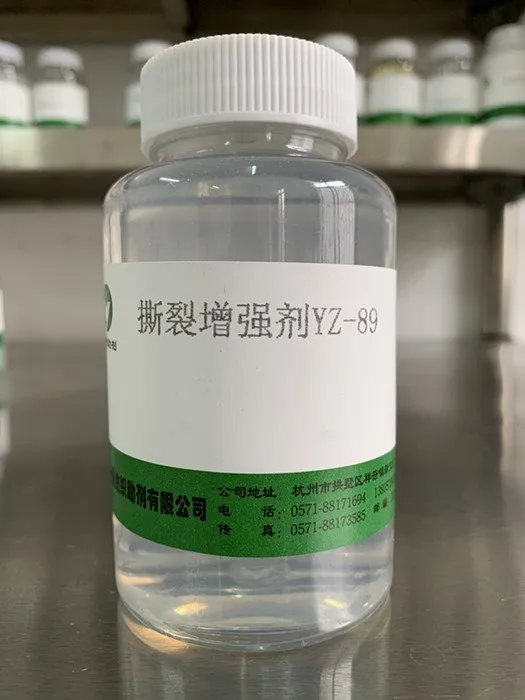
As a supplier of tear strength improvers, we offer a range of high - quality products that are tailored to different applications. Our Tear Strength Improver is formulated using advanced technology and high - purity raw materials. It has been proven to effectively enhance the tear strength of various materials, including textiles, plastics, and rubber.
In addition to our tear strength improver, we also provide other related products such as Silica Solution and Anti - sliding Agent. These products can be used in combination with our tear strength improver to achieve optimal performance in different applications.

Conclusion
Tear strength improvers play a vital role in enhancing the tear resistance of various materials, including textiles, plastics, and rubber. They work through a combination of physical and chemical mechanisms, such as reinforcement of the polymer matrix, cross - linking enhancement, and chain entanglement modification. As a supplier of tear strength improvers, we are committed to providing high - quality products that meet the specific needs of our customers.
If you are interested in improving the tear strength of your products, we invite you to contact us for more information and to discuss your specific requirements. Our team of experts is ready to assist you in finding the most suitable tear strength improver for your application.
References
- Mark, J. E. (Ed.). (2007). Physical Properties of Polymers Handbook. Springer.
- Lee, L. H. (2007). Adhesion and Adhesives Technology: An Introduction. CRC Press.
- Gent, A. N. (2001). Rubber Elasticity: A Molecular Primer. Cambridge University Press.